
Stop just thinking about your tech idea and know if it can be a business!
Guide to know if you can turn your deeptech project into a real business

Hello 👋 Reactor’s readers !
Happy to see you again here !
This guide for aspiring deeptech founders is the result of helping and leading many deeptech projects in my career. Before and during my entrepreneurship adventure with the Space Eternity project, I would have loved to read such a guide.
This is the first version of the guide and I do plan on improving it every time I see that there is a major improvement to do. Please, as usual, hit ‘comment’ below to tell me what’s missing here.
Summary
Build your mindset
Define your value proposition
Define the company you want to build in 3, 5 or 10 years
Pitch clearly your idea to ANYONE - a venture capital expert or your grandma 👵
Go out and test your idea with 5 potential customers
Build momentum around your project
Here we go !
Build your mindset - in continuous from steps 0 through 5
Building a company is not an easy task - otherwise we’ll all have a company or multiple companies.
This is one of the reasons why Reactor also exists : to show you the truth behind tech entrepreneurship. We often read the good news about company Z raising XX million € or $ after successfully tested their prototype or signing a big contract with a major player.
However, most of the time and especially during the early days of a tech business, you’ll find yourself doubting your own skills and your endeavor / project.
You will also have to cope with criticism and skepticism. You are launching a deeptech project which is by definition (the one of BPI France): bringing to the world a disruptive method / service / product.
Hence, let them be skeptical!
Remember that every idea 💡 (and it doesn’t have to be a deeptech one) go through 3 different steps :
revolutionary - no one will believe that you will be capable of doing what you said you will. Deeptech project founders cannot easily show a prototype built on the internet as the end product might needs months or years to be built. At the beginning of the project, you only own simulations which can confirm your results. You are the expert of your tech subject so as long as you are confident about your calculations, there is no need to be shaken off by critics about what you will achieve.
Violently opposed - once your public is aware that you’ll not back down and stop your idea, they might try to make you stop this time by confronting your idea with the current status quo. “Why doing things a different way? It is working properly today.” They might be right in a sense but what you are offering is doing things 10x faster/cheaper/ more efficiently. My piece of advice would be to let it go and not focus on this violence because it’s not productive.
Widely accepted : your solution works and performs as you said it would. Your former opponent cannot deny it anymore and they might even say : “I knew it all along”.
This is not new. As you can read below in this quote from Arthur C. Clarke :
“Every revolutionary idea seems to evoke three stages of reaction. They may be summed up by the phrases: (1) It's completely impossible. (2) It's possible, but it's not worth doing. (3) I said it was a good idea all along.” Arthur C. Clarke
Tips to maintain mental health and morale : for the first two steps, criticisms can be sent to your face without any form of respect and with violence. Instead of doubting the project and yourself, remember that you are coming up with a solution that is going beyond the limits of what is possible today. People are usually afraid of change and scared of the unknown. What you are offering them is something they have never thought about. Sometimes it is easy to jump into judgment but instead, try curiosity : “why is this person so upset about my project?” It will help.
Define your value proposition
To launch a business of any kind, it is essential to define the value you will bring to your customers.
In my experience, deeptech projects founders used to forget even more than other startup founders because they are too focused on their technology.
Do not get me wrong : having a solid technological advantage is essential but if no one is willing to buy your product, then you’re doing it for free or it’s not a business. It’s scientific research.
There is absolutely nothing wrong with keeping your work as scientific research or a student project. We all need those things to happen in parallel with entrepreneurship endeavors.
Not all projects are meant to become businesses because sometimes there is simply no one ready to buy the end-product.
It’s a “Go or No-Go” choice: is your project really a business ?
This is where I would like you to sit down and think about what your technology is bringing…
! Call for action !
Repeat after me and fill the blank : my tech product (name of your product) helps (typology of customers) gains (benefits: time, efficiency) / reduces (emissions ? Waste ? Employee’s stress ? ) by limiting this or increasing that.
For example:
ColibrITD’s quantum solution QUICK helps aerospace companies doing huge simulations gain time by reducing computation time.
Arkane Tech’s product Cerebro helps helicopters and aircraft manufacturers reduce the number of cables onboard by using a secure wireless technology.
A bad example would be my former project Space Eternity : I thought that having a data center constellation around Earth would benefit the entire world with a global coverage and the insurance of being safe from natural disasters. Even if that was true, it did not bring enough value to potential customers because a solution on the ground was easy to find : redundant data storage (multiple locations, multiple providers). At that time, I was lucky enough because one prospect actually saw the true value proposition of Space Eternity and told me : ensuring data security and sovereignty in space. Indeed, it is impossible to plug an usb key with a virus on one of the orbiting satellites to destroy or steal data. Plus, space belongs to everybody so data in space no longer needs to fulfill certain regulations imposed by a country.
==> That’s why it’s really interesting to listen intensively to your potential customers - see part 4 of this guide.
Define the company you want to build in 3, 5 or 10 years
I cannot stress enough the importance of this point as it will unconsciously drive all of your decisions.
A little bit of biology : The brain works in a way that it does not want to be wrong. Hence, if you think that you want a situation to happen, your actions will automatically follow the path towards that situation.
That is the reason why you want to sit down and think about this tech product - which is still an idea on a piece of paper today - and what it will be in 3, 5 or 10 years.
If you imagine running a 10-people business 10 years from now with profitable figures - enough to carry on and pay your employees comfortably, you will probably achieve this. On the contrary, if you imagine that your company will double in number of employees each year to reach 4000K people in 10 years, then all of your business decisions will derive from this vision.
Both situations can be satisfying and I am not comparing them at all. However, this is key to think about that long-term vision now because it will help you guide your actions, your employees towards the end goal and help potential investors see if this is the kind of company they are usually investing in. Doing it at the very beginning of the project is important because you still have the time to ask yourself that question. It might not be the case when you will have project deliverables to send, employees to manage, investors to find.
Pitch clearly your idea to ANYONE - a venture capital expert or your grandma 👵
Most tech founders I have encountered do not see the value of pitching well when I first met them. Indeed, they know perfectly their product and that shouldn’t be a problem to describe it during a pitch.
However, before it was a technological project, now it’s a business.
Your pitch should be clear and answer those questions :
What is the problem am I solving ?
What are the current solutions doing to trying to solve that problem ? Why is not enough ?
What is your solution ? How does it compare to other solutions ?
Why is the right time NOW to start your project ?
Why are you the only one to solve that problem with that solution ?
This speech is the formal one and each and every speech you make should be different because your audience is never the same.
When I tell tech founders to pitch their startups to their grandmothers, I am not kidding. It is a great exercise!
Because not everybody has his.her grandmother 👵 nearby, here is my …
! Call for action !
Go down in the street and tell people :
“Good morning, I am starting my deeptech startup and I would like to explain to you what I’m doing. Do you have 30 seconds to let me introduce my concept please?”
If the answer is yes, the floor is yours.
With the first person, you will stutter and search for your words, but trust me: after 5 people, you will see the benefits of this exercise !
Go out and test your idea with 5 potential customers
One of the main setbacks of tech founders is that they never feel ready to talk to potential customers.
There is a fear to have their idea stolen by the person they are talking to. Most of the time, this is nonsense : think about the number of times that people have been telling you about their own startup project and you felt this was a great idea. Did you immediately stop everything to launch the project before they did ? I hardly think so.
People are usually busy in their company / university / labs dealing with their own problems and they won’t steal your idea like that.
Plus, it is important to maintain confidence in your project. If you are talking to potential customers which are highly interested and they want to understand the technical aspects of your project, you are in your right to keep information for yourself. Another option is to ensure that a Non-Disclosure Agreement or NDA will be signed between you and them before going deeper into the details.
Discussing with a potential customer will give you real and tangible info about that problem that you think they have - and that they might not have after all -, about the current solution they currently have, the consequences of having a specific problem on their daily business operations. All those info are keys to refine your product marketing information and start using the customer’s vocabulary.
! Call for action !
Make a list of 5 potential customers for your project
Reach out to them if you have their contact info already. Else, find them on LinkedIn.
Schedule a short call with them
Prepare a strong opening line for your project by focusing on the value proposition and the benefits of your solution. (See part 3 above) Remember that people like to relate to things they know
Let the potential customer tell yourself as much as possible on his situation, the problem he has, the solution he uses and what the consequences on the whole business. Then at the end, offer your solution and ask them if they would like the benefits you’re offering.
If this is new to you (that discussion with a prospect), please have a look at this former Reactor article.
Build momentum around your project
You won’t be able to do your project alone. And that’s not bad news because you will be able to get help and support from a large tech community : laboratories, R&D companies, R&D department of large companies, universities. They can become partners, suppliers or buyers. In any case, this will increase credibility for your project as more and more people are supporting it - even if this is just with a letter of interest.
You can also develop a community of passionate techies : you can’t sell on a Business-to-Customer or B2C market but there are a ton of individuals passionate about technology and innovation. They might be super interested in following your projects, your achievements, spread your job ads, write articles about your projects and sometimes even bring business opportunities by talking to someone in their own network that was inaccessible to you.
How to do that ?
maintain a presence on social media
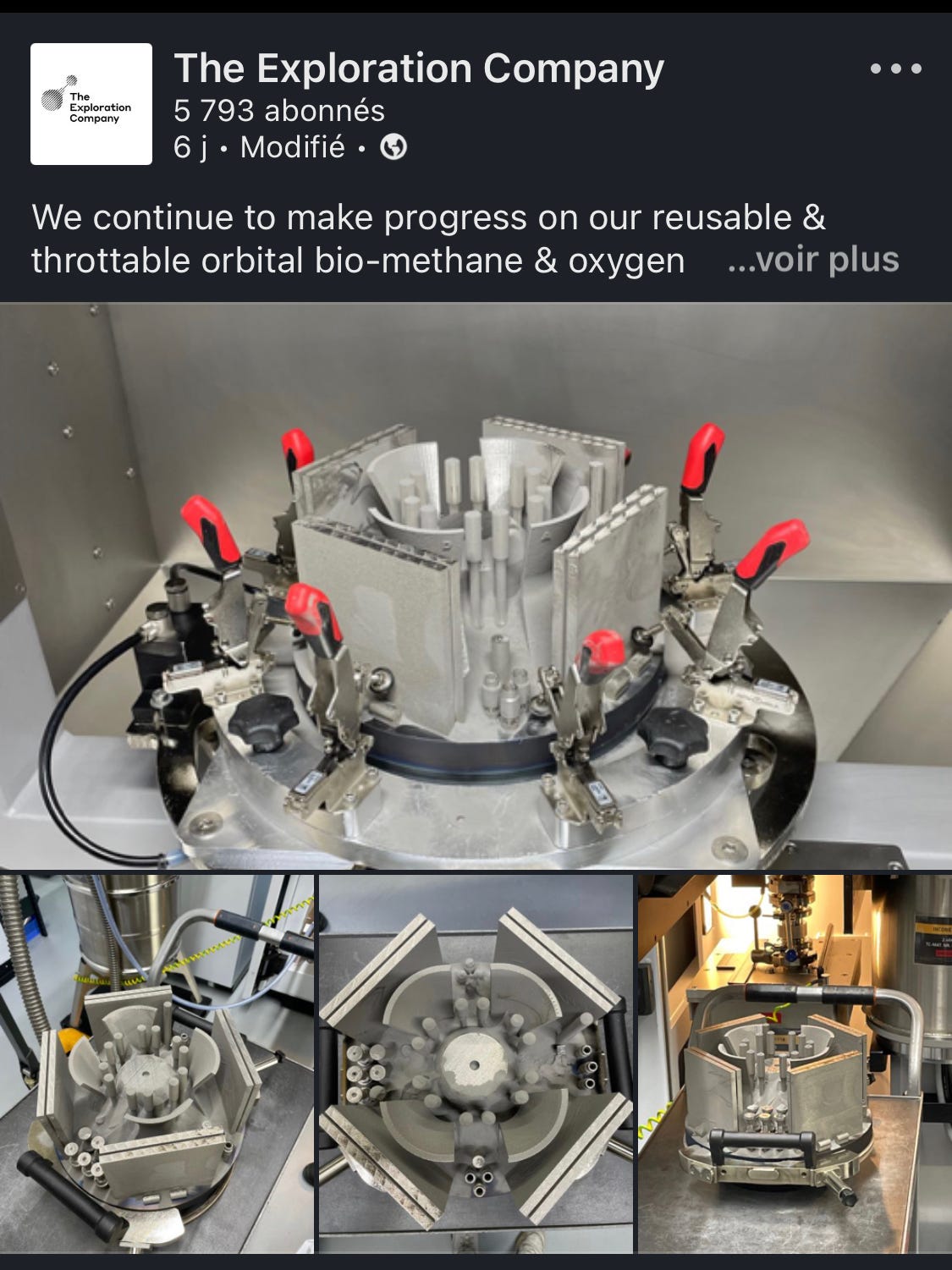
Example of The Exploration Company on LinkedIn. Even if the company is a year old in 2022 and hasn’t sent any spacecraft yet, they publicly disclose their achievements
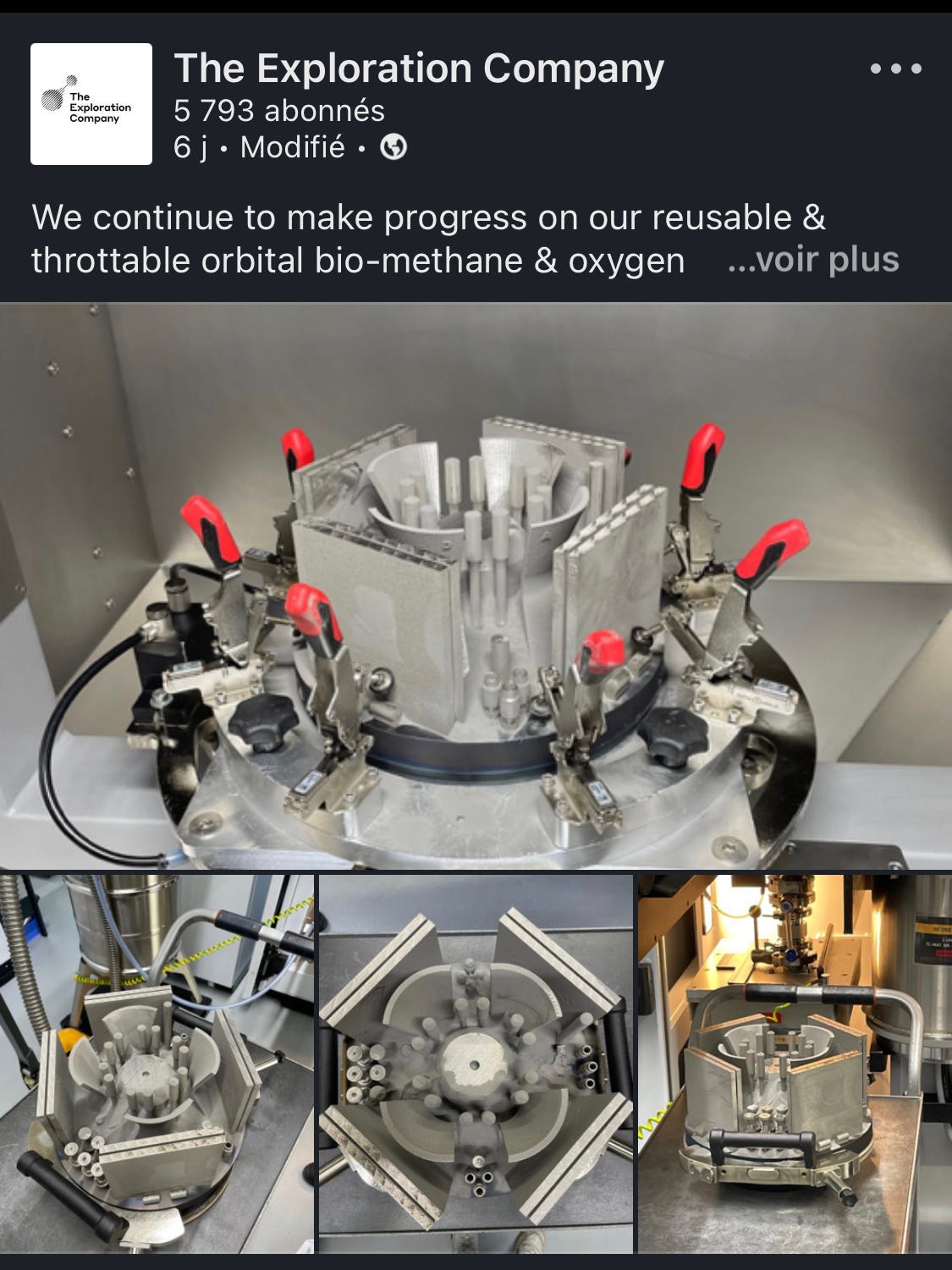
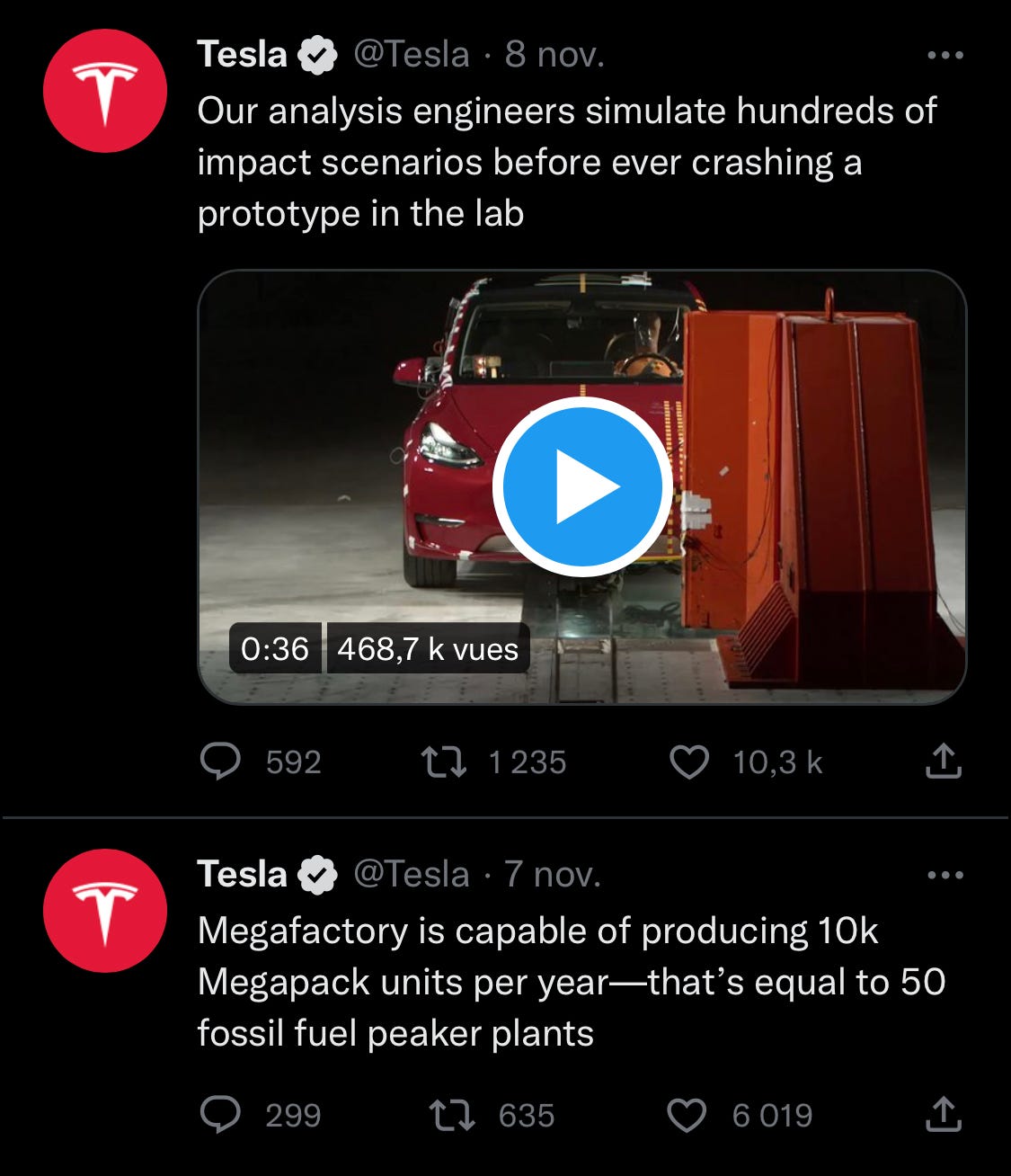
Publication of The Exploration Company on LinkedIn, Nov 7th 2022 Example of Tesla on Twitter. The electric vehicle manufacturer keeps updating its community with its newest feature.

Tesla’s Twitter posts on nov 7th and nov 8th 2022.
Write about your progress / plans / problems in a newsletter
Behind the curtain - (written by the founder) unveils the secrets behind the future mega-app for personal finance Snowball.xyz.
Share news on TV :
B-smart
Maddyness
TechCrunch
Specialized TV shows or newspapers
Communications is strategic and needs to be planned and prepared.
However, avoiding all types of communication might lead to missed opportunities and partnerships for your projects.
Building a strong ecosystem around your project is an effort worth doing.
This is the end of this guide for aspiring deeptech founders.
Please do not hesitate to like, comment and share to the person who has a “great idea that will change the world”. Yes, I’m talking to that person !